Planting
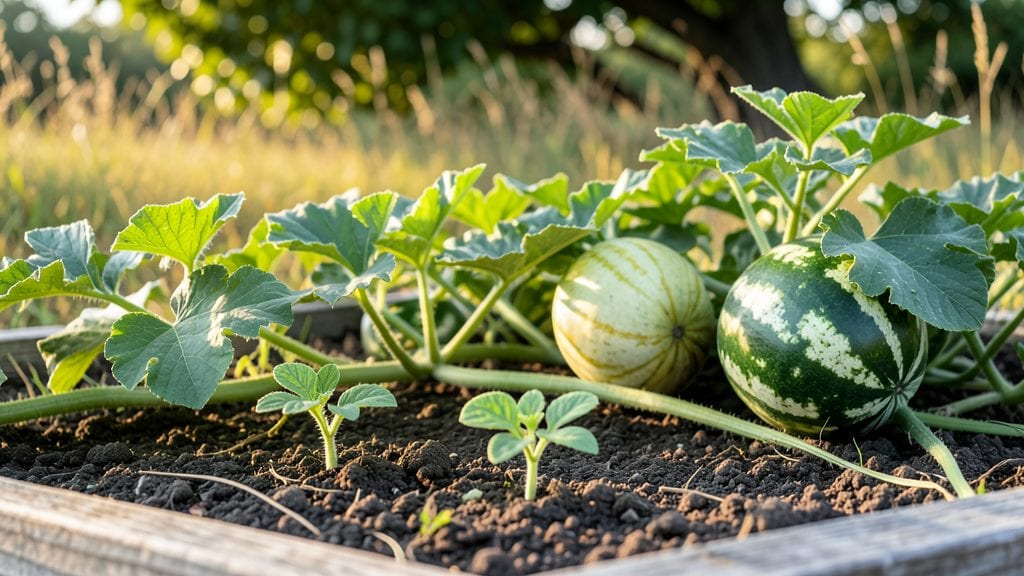
Proper watermelon garden spacing 🍉 determines whether you end up with cracked, undersized fruit or juicy, vine-ripened melons that feed the neighborhood.
Picture this: you’ve planted your spring watermelons in Zone 6, the soil is warm, and the vines are thriving—yet your harvest looks more like golf balls than the 5-pound monsters you dreamed of.
The culprit? Overcrowding. Too little space means roots compete, vines suffocate, and fruits never reach their full potential.
Watermelons need room to stretch their 15-to-25-foot vines and develop deep roots, but how much? The answer depends on whether you’re growing sprawling vining types or compact bush varieties—and whether your soil is sandy or heavy clay. Get this right, and you’ll double your yield without extra work.
Below, I break down the exact spacing rules for rows and plants, how to adjust for your soil, and the one spacing mistake that’s silently stealing your harvest every year.
Optimal watermelon garden spacing by variety type (vining vs. bush)
Choosing the right watermelon spacing can mean the difference between 10-pound monsters and stunted, cracked fruits. Vining varieties like 'Sugar Baby' sprawl aggressively, while bush types such as 'Black Diamond' stay compact.
I’ve learned the hard way—overcrowding leads to poor air circulation and disease hotspots, while too much space wastes garden real estate. The key? Match your variety to your space and climate.
For vining watermelons, think big: these plants can stretch 15-25 feet or more, sending out tendrils that need room to explore. Bush varieties, on the other hand, stay tidy within 3-6 feet of their planting spot.
If you’re working with a small urban garden or container growing, bush types are your best bet. But even they need proper spacing to thrive.
Here’s the breakdown: row distances, plant spacing, and why compact varieties outperform sprawling ones in tight spaces. Use this as your guide to maximize yield without sacrificing fruit quality.
🌱
| Variety Type | Row Spacing (ft) | Plant Spacing (ft) | Best For | Yield Potential |
|---|---|---|---|---|
| Vining (Standard) | 6-8 | 3-4 | Large gardens, trellises | High (10+ melons) |
| Semi-Vining | 4-6 | 2-3 | Medium gardens, raised beds | Moderate (5-8 melons) |
| Bush (Compact) | 3-4 | 1.5-2 | Small gardens, containers | Low-Moderate (2-5 melons) |
| Trellised Vining | 4-5 | 2-3 | Vertical spaces, small footprints | Moderate (4-6 melons) |
If you’re planting vining watermelons like 'Crimson Sweet', give them 6-8 feet between rows and 3-4 feet between plants. These vines need space to sprawl and photosynthesize efficiently.
I once tried squeezing them into a 4-foot row spacing, and my melons barely reached 5 pounds—a far cry from the 20-pound beasts I’ve grown with proper spacing.
For bush varieties, like 'Sugar Baby' or 'Black Diamond', tighten up to 3-4 feet between rows and 1.5-2 feet between plants. These compact plants thrive in small spaces and are perfect for raised beds or container growing.
Last summer, I planted 4 bush watermelons in a 4x4-foot raised bed and still harvested 3 perfect melons—proof that spacing doesn’t always mean sacrificing yield.
Why do compact varieties outperform sprawling ones in small gardens? It’s all about resource competition. In tight spaces, vining watermelons compete for sunlight and nutrients, leading to smaller fruits and higher disease risk.
Bush types, however, stay contained, allowing their roots to access more soil moisture and leaves to capture sunlight without fighting neighbors.
Pro tip: If you’re trellising vining watermelons, reduce row spacing to 4-5 feet and plant 2-3 feet apart. Trellises save space by training vines vertically, but you’ll still need to prune side shoots to avoid overcrowding.
I’ve grown 'Jubilee' watermelons on a trellis in my backyard patio, and with proper pruning, I’ve gotten 6 melons in a 3x6-foot area.
One mistake I’ve seen gardeners make is ignoring vine length when planning. A standard vining watermelon can easily <
How to adjust watermelon spacing for soil quality and climate
Your watermelon plants might be thriving in ideal sunlight, but if your soil type or local climate isn’t accounted for, you’re leaving yield potential on the table. Heavy clay soils compact roots, while sandy loam drains too quickly—both demand spacing tweaks.
Even humidity levels and heat zones play a role in how much room your vines need to avoid disease and maximize fruit size.
For example, in USDA Zone 9 with high humidity, I widen spacing by 20% to prevent powdery mildew, while in Zone 5 with drought-prone summers, I tighten it slightly to retain moisture.
The key is balancing root competition, air circulation, and water retention—all of which shift with your growing conditions.
🚨 key takeaway 🚨
Watermelon Spacing Adjustments
Soil Type: Heavy clay (+20% spacing), Sandy loam (-15% spacing)
Climate: High humidity (+15-20%), Drought (-10-15%)
Heat Zones: Zones 9-11: +10-15% for airflow
Start with the standard spacing of 3 feet between plants and 6 feet between rows for vining varieties. But if your soil is clay-heavy, increase plant spacing to 4 feet—this prevents roots from suffocating and encourages deeper growth.
In sandy soils, however, you can reduce spacing to 2.5 feet since water drains too fast, and roots won’t compete as fiercely for moisture.
Climate also dictates fine-tuning. In hot, dry regions like Arizona or California, I space plants 10-15% tighter to conserve soil moisture, while in humid zones like Florida or Louisiana, I widen spacing by 15-20% to improve airflow and reduce fungal risks.
Even elevation changes matter—high-altitude gardens (above 5,000 feet) often need 5-10% more space due to thinner air and slower vine growth.
Don’t overlook microclimates within your garden. A south-facing slope bakes faster, so I space plants 10% wider there to avoid heat stress. Conversely, a north-facing area with cooler temps can handle slightly tighter spacing.
Pro tip: Use a soil moisture meter to monitor drainage—if water pools after 24 hours, your spacing is too tight for clay soil.
For container gardening, adjust spacing based on pot size. A 5-gallon container holds just one plant with 12-inch spacing, while a 20-gallon raised bed can fit 3-4 plants in a 3x3-foot grid. In both cases, prioritize well-draining mix with 50% compost to mimic loose, fertile soil.
Finally, watch for early signs of stress: yellowing leaves, stunted vines, or small fruits signal overcrowding. If you spot these, thin plants immediately or prune excess vines to 50% of their length.
In disease-prone climates, remove affected leaves and space remaining plants 30% wider to break the infection cycle.