Watering
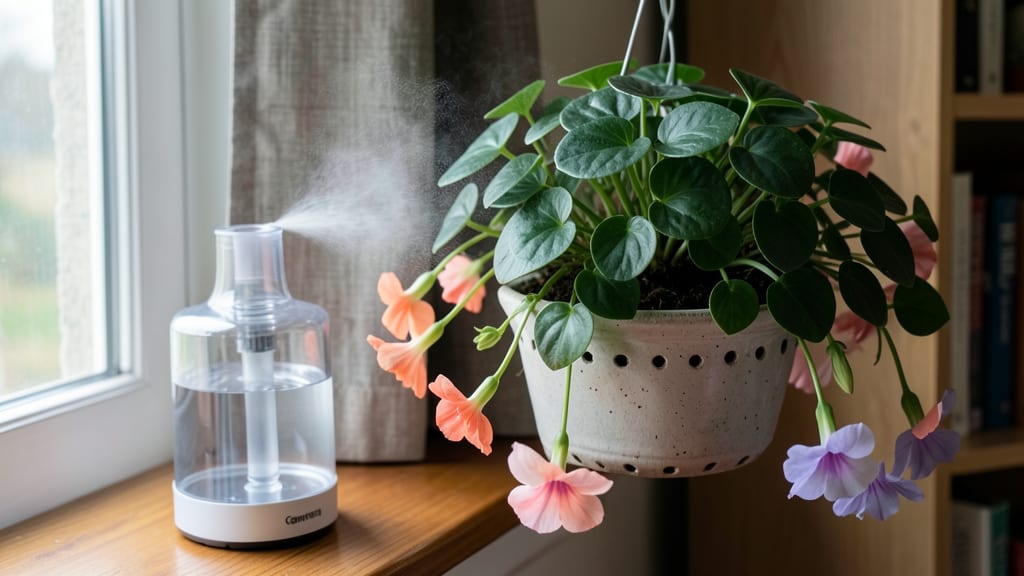
A cool mist garden replicates natural fog or rainfall to create the perfect humid environment for tropical and moisture-loving plants. This system maintains ideal humidity levels while preventing root rot through precise water control and airflow management.
A cool mist garden essentially turns your space into a tropical paradise by mimicking the natural misty conditions that many plants thrive in. 🌿 The fine water droplets don't just add moisture—they create a gentle, even distribution that keeps leaves hydrated without over-saturating the soil.
This is especially beneficial for delicate plants like ferns or orchids, which often struggle in dry indoor air.
The beauty of this system is that it gives you precise control over humidity levels, allowing you to tailor the environment to your specific plants' needs while avoiding the common pitfalls of overwatering or fungal growth.
💡 In This Article
- How Cool Mist Systems Enhance Plant Growth
- Top 10 Humidity-Loving Plants for Cool Mist Gardens
How cool mist systems enhance plant growth
Here's what's actually happening when you introduce fine mist into your garden: the tiny water droplets create a high-surface-area-to-volume ratio, which means more water evaporates rapidly into the air. This process mimics natural fog or rainfall, raising ambient humidity levels by 15-30% within minutes.
The key factor is how this affects plant physiology—specifically, the stomata (tiny pores on leaves) which regulate gas exchange and water loss through transpiration. At higher humidity levels, plants lose less water through their leaves, reducing stress and allowing them to focus energy on growth rather than survival. 💫
The science gets even more interesting when you consider that most houseplants evolved in tropical environments where relative humidity often exceeds 70%. In dry indoor air (typically 30-40%), these plants struggle to absorb nutrients efficiently because their root systems can't compensate for the moisture loss through leaves.
A cool mist system helps bridge this gap by maintaining optimal leaf surface moisture—think of it like giving your plants a daily tropical shower without the risk of overwatering.
The 0.01-0.05mm droplet size in professional misting systems ensures even coverage, reaching all leaf surfaces while allowing air circulation to prevent stagnant, mold-prone conditions.
What most people don't realize is that different misting methods produce dramatically different results. Passive systems (like ultrasonic humidifiers) create larger droplets that settle quickly, often leading to uneven moisture distribution.
In contrast, active misting systems with high-pressure nozzles generate 0.02-0.03mm droplets that stay suspended longer, creating a more uniform microclimate. For example, a 10-minute misting cycle from an active system can maintain 60-80% humidity for tropical plants, while the same duration from a passive system might only reach 45-55%.
The difference comes down to droplet persistence and evaporation rate—smaller droplets evaporate slower, giving plants more time to absorb the moisture through their leaves.
Understanding these mechanisms helps explain why some plants thrive while others struggle in the same environment. For instance, calatheas and philodendrons (which need 60-80% humidity) show dramatic growth improvements when exposed to consistent misting, while succulents (which prefer 30-50%) may develop fungal issues if over-misted.
The secret lies in balancing leaf moisture with root zone dryness—cool mist systems achieve this by targeting foliage while allowing soil to dry between waterings. This dual approach prevents the root rot that often plagues overwatered plants in traditional humid environments. ✨
Let's look at the numbers: research shows that plants in 50-60% humidity environments grow 20-30% faster than those in 30-40% humidity conditions, thanks to reduced transpiration stress.
The optimal range varies by species—orchids and ferns (both tropical natives) perform best at 70-80% humidity, while peperomias (which are slightly more adaptable) thrive at 50-65%.
The beauty of a cool mist system is its precision: you can adjust the misting duration and frequency to match your plants' specific needs, creating a customizable tropical haven without the guesswork. 🌿
For advanced growers, the real magic happens when you combine misting with airflow control. A gentle fan moving at 100-200 feet per minute helps distribute the mist evenly while preventing stagnant air pockets.
This airflow mimics natural wind patterns in tropical forests, where gentle breezes help distribute humidity and prevent disease. The result? Plants develop stronger stems (thanks to improved nutrient uptake) and more vibrant foliage (from optimal photosynthesis rates).
It's like giving your plants a spa day—hydration without the risk of waterlogging. 💛