
Pests
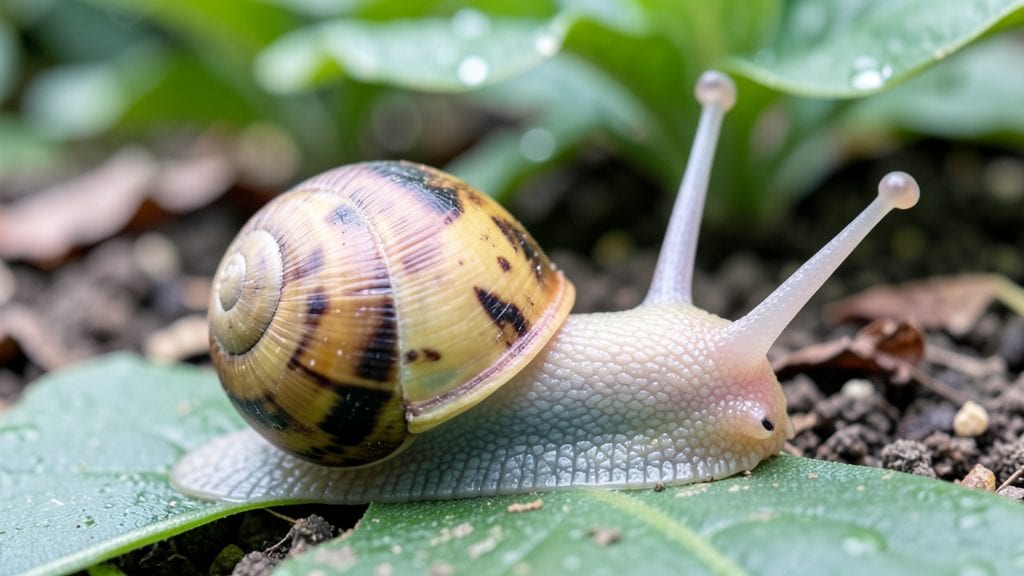
Understanding garden snail anatomy reveals why these pests are so effective at destroying plants. Their soft, muscular body, protective spiral shell, retractable head with sensory tentacles, and mucus trail all work together to create a highly efficient plant-eating machine.
These creatures' most fascinating feature is their radula—a ribbon-like tongue lined with thousands of tiny, chitinous teeth that act like a file against plant surfaces. 🔥 The two long tentacles on their head aren't just for show either; they're packed with light-sensitive eyes and chemical sensors that help them navigate toward food at night.
Their slimy mucus isn't just for gliding—it contains enzymes that begin breaking down plant cells even before the snail starts eating, making their meals easier to consume.
What's particularly interesting is how their shell shape varies by species and age. Younger snails have tighter coils, while adults develop broader, more pronounced spirals that can reach up to 2 inches in diameter.
This anatomical diversity isn't just for show—it affects how they move through different garden environments, from dense foliage to open soil surfaces.
💡 In This Article
- How Garden Snail Anatomy Enables Plant Damage
- Identifying Snail Body Parts for Effective Pest Control
How garden snail anatomy enables plant damage
Here's what's actually happening when snails wreak havoc in your garden: their radula is a biological marvel with up to 25,000 microscopic teeth arranged in rows along a flexible ribbon.
These teeth, made of chitin, can scrape through plant cell walls with incredible precision—think of them as nature's version of a Swiss Army knife for plant destruction.
The radula moves in waves, allowing the snail to consume 0.01 to 0.02 grams of plant material per hour, which may sound small but adds up to significant damage over time. 🔥
The snail's mucus trail isn't just for smooth gliding—it's a multi-purpose biological tool. This slimy secretion contains enzymes that begin breaking down plant cell walls even before the snail starts eating, making the plant tissue easier to consume.
The mucus also serves as a protective barrier against dehydration and physical abrasions while the snail moves. Interestingly, the chemical composition of the mucus varies slightly depending on the snail's diet, creating a feedback loop where their feeding habits actually influence their own movement efficiency.
Their two sensory tentacles play a crucial role in navigation and food detection. Each tentacle contains thousands of sensory cells, including eyes at the tips that can detect light and movement, and chemical sensors along the length that can identify plant odors from up to 10 inches away.
This dual sensory system allows them to locate food sources even in complete darkness, which is why they're most active at night.
The upper tentacles (the longer pair) are more sensitive to light, while the lower ones (often shorter) are specialized for chemical detection—like having built-in night vision goggles and a scent tracker combined. ✨
The spiral shell isn't just for protection—its shape and size directly impact the snail's feeding behavior. Younger snails with tighter coils are more agile in confined spaces like dense foliage, while adults with broader shells can exert more force when scraping plant surfaces.
The shell's calcium carbonate composition makes it both lightweight and strong, protecting vital organs while allowing the snail to retract completely when threatened. This anatomical adaptation explains why they can survive in gardens for months, continuing their feeding even through adverse conditions.
What most people don't realize is how their body segmentation contributes to their efficiency as pests. The muscular foot (which makes up about 70% of their body weight) is divided into three main parts: the head, the visceral mass, and the foot itself.
This segmentation allows for independent movement of different body parts, enabling them to navigate complex garden terrain while maintaining constant contact with their food source. The foot's underside contains specialized cells that secrete the mucus while also providing traction on various surfaces, from smooth leaves to rough soil. 💫
Consider these key factors when understanding their pest behavior:
- Radula efficiency: Can process 10% of their body weight in plant material daily during peak activity
- Tentacle sensitivity: Can detect chemical cues from damaged plants, drawing them to already compromised vegetation
- Shell protection: Allows them to survive multiple pesticide applications by retracting completely
- Mucus production: Can secrete up to 10 times their body weight in mucus daily during active periods
The combination of these anatomical features creates a perfect storm for garden destruction. Their ability to detect, reach, and consume plant material with such efficiency makes them one of nature's most persistent plant pests.
Understanding these mechanisms helps gardeners develop more targeted and effective control strategies that disrupt their feeding patterns rather than just attempting to kill them outright. 🌟